

How do consultants get paid more – a burning question keeping experts awake at night. If you’re a consultant, then you might want to know how much consultants can get paid? Here’s a bit about how consultants get paid and the factors which can impact the consultant’s pricing journey and all details around how much consultants can get paid if they have an understanding of these factors.
The pay of a consultant gets determined by different factors in play. The cost of a consultant or how do consultants get paid for their consultation services or per hour is a debatable question in this current world.
Most often, the payment or the cost of a consultant is decided on an hourly, daily, monthly, project-based, or value-based basis. There are also some platforms that fix the cost of one call or one consultation or even a package themselves, and a certain amount of it goes to the consultant.
Read the Full Guide :
How Do Consultants Get Paid – Different Pricing Models
What are the ways experts are getting paid by enterprises and clients?
1. Payment is in a per-hour model
Experts will be able to charge per hour for the work they deliver in that hour to the client. With a simple, transparent billing system, it can often be challenging to estimate the right cost of the total project with this payment model in mind.
- Pros: The pay-per-hour model offers a flexible payment system for experts on projects without an undefined scope.
- Cons: The project cost for expert payment cannot be estimated correctly. If the pay per hour model is not used the right way, it might actually work towards incentivizing inefficiency.
- Pricing: How much do consultants get paid per hour? Almost $30 – $500.
2. Receiving Payment Per Project Model
A fee for an entire project, irrespective of the hours spent on it.
- Pros: The payment per project model makes the project structure more predictable for an expert as well as their clients. It motivates the expert to complete the project within a particular time frame.
- Cons: One must carefully scope the scenario and derive an estimation for ensuring fair compensation. It may not be the right pricing model for projects having requirements that keep evolving by the day.
- Pricing: $500 – $10000
3. Retainer Agreement
For having access to your services, clients agree to keep paying you a monthly fee.
- Pros: A retainer agreement provides a steady income stream for you. It improves client-side and expert-side predictability patterns.
- Cons: Defining the scope of work can be extremely challenging when the retainer fee model is considered.
- Pricing: $500 – $3000 per month
4. Result-Based Fee
Your compensation is tied to specific outcomes or achievements in the process.
- Pros: Your interests and client goals can align better.
- Cons: It is difficult to objectively measure and quantify results.
- Pricing: Depends on results
5. Milestone-Based Payment
Specific milestones, when completed, bring in payments.
- Pros: With its use, you derive a sense of satisfaction, a sense of progress and direction.
- Cons: One must carefully plan which milestone will bring them how much as payment. They need to appropriately come to agreements based on milestones. If the milestones are not clearly defined, it can lead to disputes.
- Pricing: Milestone-based
6. Commission-Based Model
The compensation is based on the sales and revenue generated as an outcome of your consulting services.
- Pros: If the expert’s work directly impacts the bottom-line message of clients, then this can be a highly lucrative payment model to use. It will suitably increase sales for a client and revenue growth for a consultant.
- Cons: Income is not guaranteed and may not be the right step for all kinds of enterprise-level projects. One needs to make the payment model choice carefully for such project types.
- Pricing: How much do consultants get paid through the commission-based model (up to 30% often can be claimed)
7. Equity-Based Model
How do consultants get paid for equity-based models? In some cases, clients agree to pay you equity in their company as a payment model.
- Pros: An equity-based model is a long-term investment model in general.
- Cons: It is important to carefully analyze the company’s capabilities and negotiate a fair equity stake.
- Pricing: As per the equity provisions of an enterprise
8. Profit Sharing Model
You will need help generating whatever profits a client in order to receive a share from them.
- Pros: Obvious alignment of your interests with the client’s successes.
- Cons: The cost of a consultant as determined by the profit-sharing model requires trust-building between the client and the expert and needs to have financial reporting transparency in place.
- Pricing: Up to 10% profit from the enterprise profit usually can be shared with the expert at times.
9. Hybrid Payment Models
A mixture of different payment forms is often used to pay an expert.
- Pros: Flexible payment terms for meeting the needs of both the client and the consultant.
- Cons: It is more complicated to manage the entire payment process and might need additional negotiation and agreement terms in place.
- Pricing: Mix models will have better charging windows for experts.
10. Value-Based Pricing Models
How do consultants get paid depends on the value an expert delivers to his/her clients.
This process works greatly when experienced consultants are involved.
- Pros: Experts can charge premium rates for high-value services.
- Cons: If you, as an expert, you want to charge more, than you must understand what value your client is proposing for you. It could be challenging to implement certain types of consulting projects.
- Pricing: Pricing depends on the value an expert brings to a project. depends on the value an expert brings to a project.
Different factors regulating how much do consultant gets paid
- What kind of experience level segregation exists?
- Automation and its impact on payment of a consultant
- Impact of productivity on the pay of a consultant
- Specialized skill sets can always raise the pay scale
- Change in market competition
- Economic Perspective Change
- Different niches of consultants get paid differently.
What Kind of Experience Level Segregation Exists?
How do marketing consultants get paid? How do business consultants get paid? What are the different levels of segregation that determine the cost of a consultant?
- Entry-Level: Typical roles are those of an analyst or associate levels.
- Mid-Level: Engagement managers, principals, and partners.
- Senior-Level: Senior consultants, principals, and large teams led and managed via complicated client relationships.
- Diversification and Specialization: Specific specialization models for diversification and other kinds of specializations.
How much do consultants get paid? Here’s an image where we see how much does AI automate and what can be its impact on expected compensation?
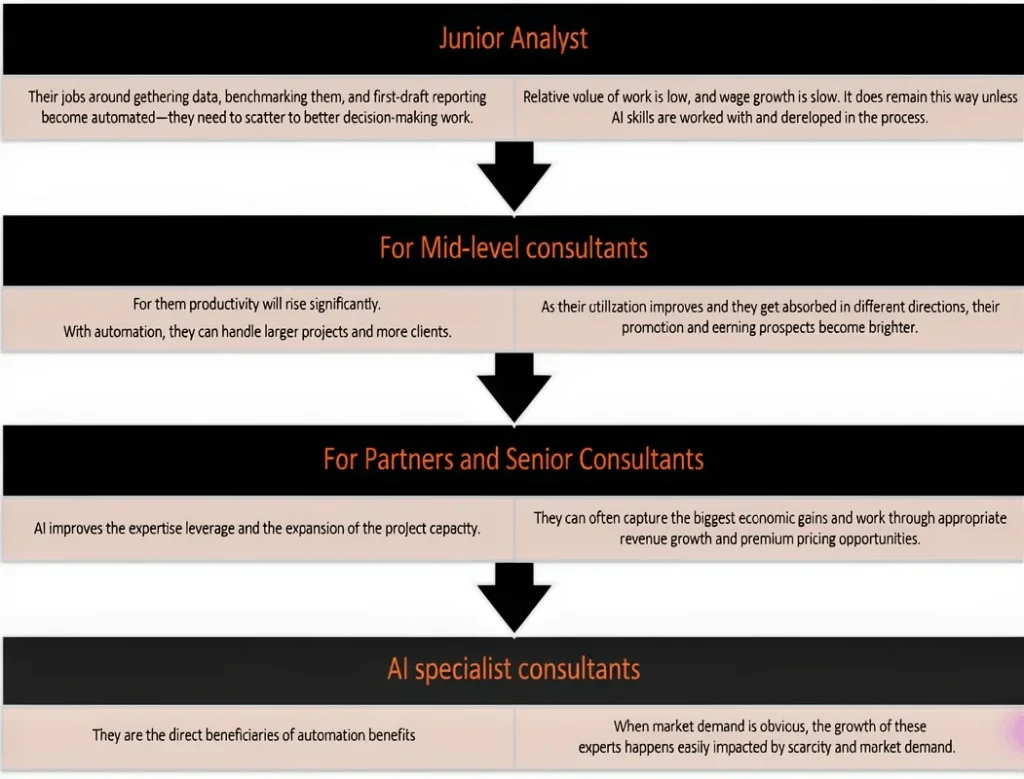
Impact of Automation on Consultant’s Pay Through Demand Compartmentalization Shift
Since automation has brisked up the pace of enterprises, productivity demands have gone up for employees in areas where AI is making an impact. How much do marketing consultants get paid? How much do business consultants get paid when AI is set to automate almost every repetitive task?
In short, different repetitive tasks can be automated using AI, and that can impact the cost of a consultant. From data collection to report generation, basic financial analysis, and standardized recommendations, repetitive tasks can be automated easily.
Gone now are the days when consultants could simply charge for performing these tasks. Those who did charge based on these activities cannot any longer charge for these activities at all.
How much consultants get paid depends on the different niches and their AI and automation efforts, with the shifting impact of higher pricing demand for consultants.
| Consulting Niche | What Gets Automated | Evidence | Impact on Demand for Consultants |
|---|---|---|---|
|
Management Consultants |
Research, synthesis, slide drafting, market analysis, and idea generation get automated. |
It was seen in 758 BCG consultants that GPT-4 users completed 12.2% more tasks, performed 25.1% faster, and had improved quality by 40% on tasks within AI’s capability frontiers. [Source: HBS] |
Demand will shift more towards the following:
|
|
Strategy Consultants (computer engineers, lawyers, judges, business + financial analysts, account managers, gaming workers, maths specialists, engineers, entertainment and media workers, teachers, building engineers, social workers) |
Market scanning, CI (competitive intelligence), scenario modeling, and document review |
McKinsey estimates show experts can have 1/3rd free time since AI would automate knowledge work activities in many different professional occupations significantly. [Source: Factcompany] |
Demand will increase for experts who can convert AI’s insights into business decisions |
|
Technology or AI Consulting |
Automation is the product, and consultants use AI tools while advising clients on adoption |
According to a McKinsey survey, 40% of surveyed organizations will increase AI investment due to advances in generative AI [McKinsey] |
Demand will increase for the following:
|
|
Operations Consulting |
Decreased manual analysis time through these automations:
|
Generative AI and automation drive substantial productivity developments across different operational functions. |
More of operating model redesign, and automation deployment expertise become relevant |
|
Service Consulting or Customer Experience Consulting |
AI will handle larger portions of customer service interactions and different forms of analysis |
NBER published 5179 customer agents who found AI improved productivity by 14% on average and 34% for less experienced workers available [source: NBER] |
Demand has shifted more towards model risk management, AI controls, and governance |
|
Financial/Risk Consulting |
|
McKinsey identifies different business and financial specialists among different occupation types and brings in substantial automation potential from the use of generative AI [source: Fastcompany] |
Demand shifts to governance, model risk management, and AI controls |
|
Legal Consulting/Regulatory Advisory |
Contracts, regulations, case materials—review gets done quicker |
McKinsey states that even legal work is highly gaining from automation and productivity profiting tasks [source: McKinsey]. |
Demand in this case will shift to negotiations, interpretations, and complicated judgement |
Impact of Productivity on the Pay of Consultants
From the above table, we determine how automation is changing, what will get paid more, and what will get paid less.
Metric | Potential Pay Implication |
BCG consultants using GPT-4 | Billable output is higher per consultant thereby support in the form of compensation and promotion rates becomes way higher in the process |
Customer service workers when using AI. | With automation, skill differences get compressed significantly, and at lower levels, it impacts the premium costs for routine expertise. |
Automation of knowledge worker potential. | Those who use this time to provide advisory work will benefit from higher pay, and those who do not will face a bit of pressure. |
Specialized skill sets can always raise the pay scale
Those who are already migrating to developing machine-based technologies can earn higher wages. Why? Their expertise is extremely scarce right now.
Examples include AI consultants, automation strategy consultants, digital transformation experts, and data analytics experts.
Change in market competition
Machines can significantly lower the consulting service costs. It can lead to increased market competition, allowing clients to perform some tasks themselves.
They will reduce the fee for basic consulting services, and only if the experts bring in home strategic judgment, relationship management, and creativity will they then be highly valued and priced.
Economic perspective change
From an economist’s perspective, AI is a skill-biased tech change or alteration. Tech inception has increased the earnings of highly skilled workers, those who can complement machines.
Technology will reduce worker earnings further—specifically those whose skills gets replaced using machines.
Different niches of consultants get paid differently
Different niches have different pay grades. A space astronaut’s pay grade is different from those of a janitor and a software engineer.
With the help of machines, experts can complete tasks way too fast. They can improve work accuracy to the maximum level. Ideally, machines can improve the work rate of a consultant. They can improve the quality of insights and can even take on more complicated projects and tasks.
If a management expert helps a client with an AI tool, it can decrease the time taken to analyze data for generating suitable recommendations. Thus, the pay will be reduced. But, this pay reduction needs to be suitably filled up with something more essential workwise to retain getting paid for what they usually were paid before AI.
Given these factors, a consultant could bill more if they focus on improving these few aspects.
What Factors Should You Change to Raise Your Fees?
Here’s a list of factors to consider for raising your fees.
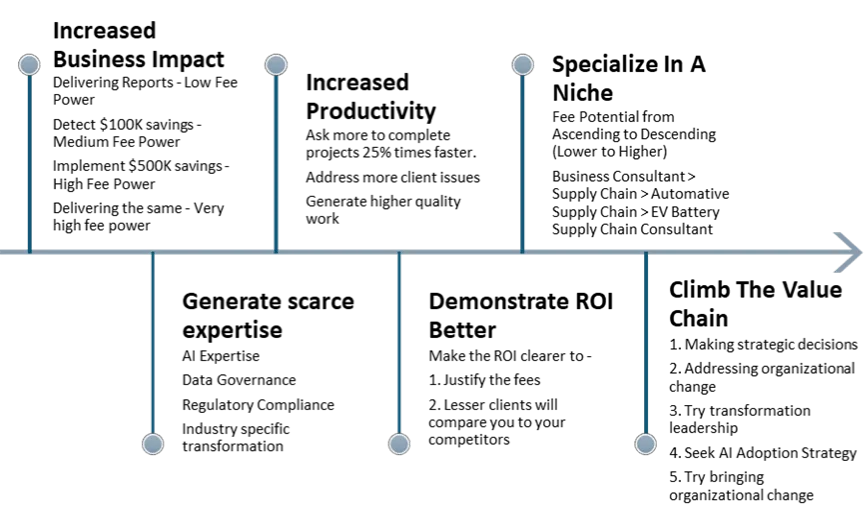
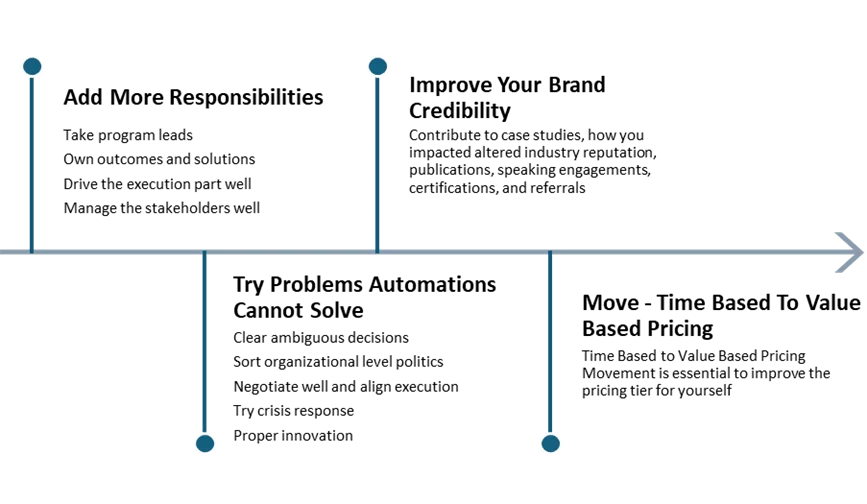
How To Determine Your Pricing?
Here are a snapshot of the inner work and the processes in place to determine your pricing as an expert.

FAQs
How are consultants normally paid?
The most popular payment method for consultants is the pay-per-hour model. Usually, experts get paid through this model more than any other even in 2026.
Why are consultants paid so high?
Ideating is always difficult from doing a task. Hence, experts get paid highly since they help enterprises see the gaps well. They tell enterprises how they see the holes and what they plan to do about it.
What is the best way to get paid as a consultant?
The best way to get paid as a consultant often depends on the factors an expert considers important. From all the different models, while conversing with clients, they can choose the ones that fit them the best.
How do consultants bill clients?
They can generate invoices, and these invoices must have an audit trail. Usually, billing through invoices is one of the most legally safe procedures for collecting money due to them from a project.
How to accept payment as a consultant?
You could use any of the ways to accept payments as a consultant. Most experts try bank transfers, wallet transfers, UPIs, PayPal, Venmo, and even Stripe to collect their payments.
How are consultants typically paid?
The article above mentions hourly, value-based, outcome-based, and many other types for reference.
Can you pay consultants based on results?
Yes, you can pay consultants based on results.
When should the fees be increased?
Precision expertise means offering clearly scoped, decision-focused engagements tied to specific outcomes.
How does automation impact consultants’ pay?
Since many tasks get automated, consultants might have to charge less, but then if they can improve themselves on any front, they can still earn highly.
Conclusion
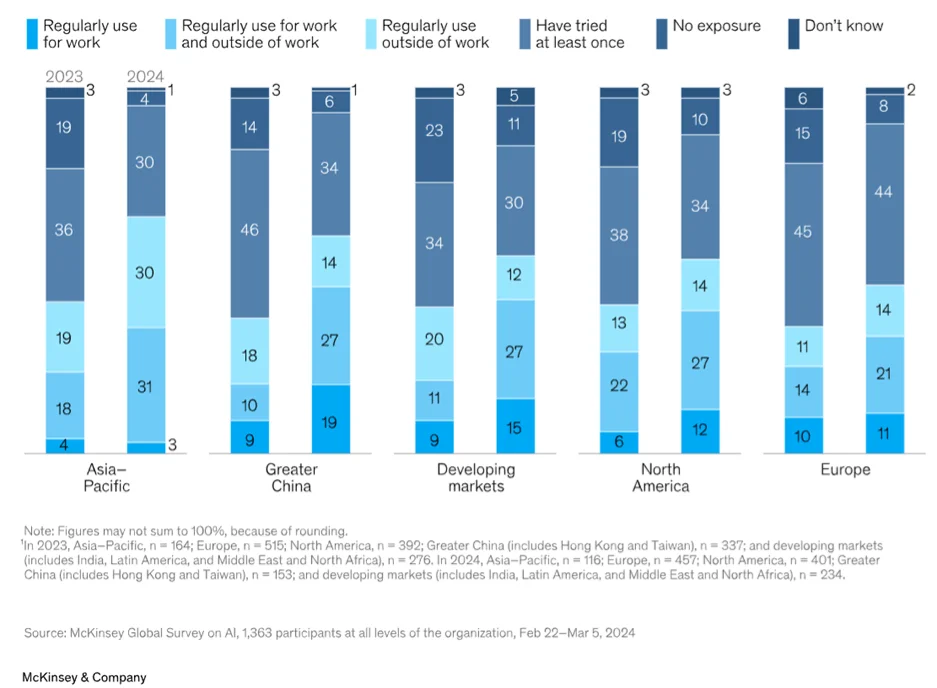
McKinsey and Company report that the number of industries, individuals, positions, and niches using generative AI is significantly higher today than yesterday.
In such circumstances, most markets are finding it hard to pay so much to their human expert counterparts unless experts make significant changes in the ways they work.
Incorporating an expertise layer improving productivity and daily capabilities that cannot be regulated well with AI can still offer good pay to consultants.
A subscription-based platform, for example, could work wonders for an expert rather than a commission-based platform. Platforms can be lifesavers in this era since they can keep the inflow of clients intact while you improve yourself as an expert on different fronts.
The better you become, the more you can raise your pay. The more experienced you are in a niche, the more different types of payment models you can try for yourself.
Where do you get a model platform these days when all of them have some defects experts like to avoid?
Why not try VirtUp, an emerging 0-commission, 0-hidden-fee platform with no lock-in?
What you earn, you get to keep it all. No middleman platform fees and a lot more benefits you can only hope to have by your side. Plus, you can set your own prices, and clients need to align with your pricing requests if they want to take your services.